
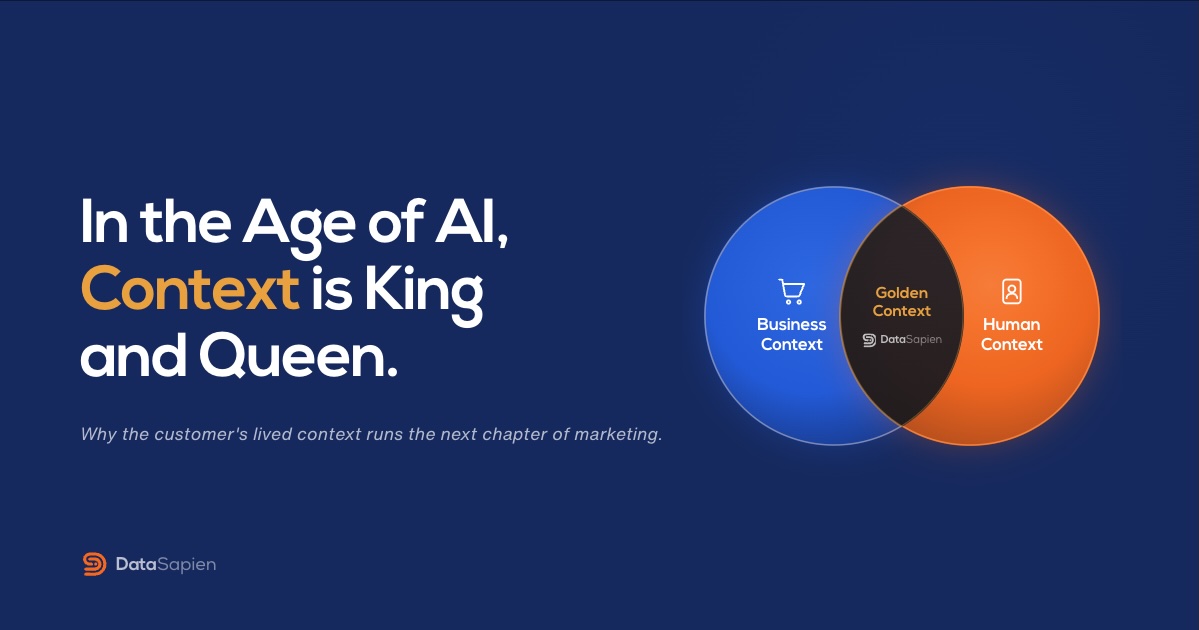
Standfirst. Customer is King drove e-commerce. Content is King drove digital-social. AI and Agents now hand the crown to context, and the customer’s lived context is finally reachable. The place where business context meets human context has a name, a diagram, and an architecture that can reach it.
Customer. Content. Context.
Customer is King drove the e-commerce economy. Content is King drove the digital-social one.
AI and Agents are the next engine. Cloud-side generative AI is part of where this chapter lands, but the bigger prize is the architecture that lets AI meet the customer where the content era never could: in their lived context, in real time, with permission, inside a system that can act on it.
Relevance lives in the interaction now. The interaction lives in the customer’s context, on the device they carry every waking hour.
Context is King and Queen. Every customer served as themselves, not as a model or shadow of themselves.

Business Context
Business Context is what your organisation already has: the cart, the CRM, the CDP, the catalogue, the offers, the brand promise, the segments, the governance. Most large consumer enterprises have spent ten to fifteen years and significant capital assembling it. Most of it works. Almost all of it is necessary.
What Business Context cannot do, on its own, is reach the customer. It is the view from the company’s side of the glass. It knows what you sell, and what a customer bought. It never knows why, or how that why might change with their lived context.
Human Context
The lived Human Context enables personalisation to work beyond the constraints of a narrow customer view. It is the individual’s lived experience: where they are, what they are doing, who they just spoke to, what they searched, what is in their calendar, what their mood is, what they need next. It enables the local assembly of experiences within the customer’s live life-stream, reflected digitally from the device they carry in their pocket every waking hour.
This data already exists, in volume, in real time, with extraordinary fidelity. It lives in one place only: on the device, under the customer’s control. That is not a constraint to engineer around. It is the architectural fact the next chapter has to be built on.
Why we redrew our own diagram

The diagram we were about to put on the homepage looked like this. Two circles, DataSapien in the middle as the fusing mechanism. It was an accurate diagram of what we do. It was also a product diagram dressed up as a category diagram, with the brand name doing the work that the category should be doing.
The new diagram names the prize first, and puts DataSapien underneath as the platform that makes the prize reachable. That is a more durable position, and the one that lines up with how we have been writing for the last two years. The CDP has been waiting for this. We are the layer underneath, not the alternative.
Great minds, same picture
When the ground shifts, many people feel it at once. We were delighted to see Scott Brinker (chiefmartec) and Frans Riemersma (MartechTribe) name “Golden Context” in their State of Martech 2026 report, published on 5 May 2026. It is a deliberate play on the old Golden Record aspiration of the CDP era. The Golden Record was the customer-360 holy grail of the data-warehouse decade. Golden Context is the natural successor noun for the era that follows.
Brinker and Riemersma’s framing puts three sets in the Venn: Customer, Company, and Systems. We have drawn ours with two circles. The systems live inside the business context already, and with DNA³ (below) they now live inside the customer’s lived context too. Two circles, because the systems are inside both halves. Same idea, different geometry. Scott and Frans’s phrase gives us all the right noun to put there.
The Golden Context, and where it lives
The Golden Context is where Business Context and Lived Human Context meet, in real time, with the customer’s permission, inside a system that can act on the meeting. It is not a data set. It is not a profile. It is a moment, assembled when the conditions for it exist, surfacing the right brand response when both halves of the relationship are present.
The detailed diagram below makes the architectural claim explicit. The lens contains a single bullet: Assembled On-Device. That is the answer to Brinker and Riemersma’s Systems question, and the answer to every CDO’s implicit fine, but where? On the customer’s device. With their permission. In real time.
This is also the moat. The place where the organisation’s context meets the customer’s lived context, with both sides intact and both permissioned, is the most defensible position in the marketing stack. Relevance becomes a property of the interaction, not the campaign.

Why this has been out of reach
Even today’s most sophisticated cloud-based personalisation platforms model the customer from a distance. They trace a chalk outline of the person and personalise against the outline. It works for the 5% of customers who are in-market right now. It distorts further for the 95% who are not, because the outline wears thin with age. The CDP, for all the value it delivers, holds the company’s view of the customer, not the customer’s lived view of themselves. Hyper-personalisation tries to close the gap by extraction, and runs into the consent collapse, the regulator, and the creep-out paradox.
Device Native AI inverts the architecture. The intelligence moves to where the lived context already is, instead of a person’s entire lived context having to move to where the intelligence is hosted, in a data centre in Wyoming. The Golden Context becomes reachable because the system that assembles the moment finally sits where both halves can meet. We have written about that shift at length in our Device Native AI explainer and the longer OmniPersonal Marketing piece.
Where DataSapien sits: DNA³
DNA³ (Device Native: Attributes, AI and Agents) is the SDK that drops into your existing iOS, Android, React Native or Flutter app and assembles the lens at runtime. Three layers, three jobs:
- A1, Attributes. One live profile per device, no new silo. Behavioural, transactional, declared and inferred signals merge into a single live customer profile, running natively on your customer’s own device. Your CDP and warehouse stay where they are, enriched by a live first-party signal source that did not exist before.
- A2, AI. Models that run where the data lives. Personalisation, segmentation, scoring, classification and ranking execute natively on the device. No round-trip to the cloud. No latency tax. No honeypot.
- A3, Agents. Orchestrate actions across customer life domains, on your terms. Trigger workflows, compose interactions, and route actions across your existing systems through a no-code interface. You define what acts, where, and under what conditions.
DNA3 is the harness for Attributes, AI and Agents that delivers on-device personalisation. It collects, structures and acts on first-party signal where it is freshest, on your customer’s own device, and makes that intelligence composable with your CDP, campaign tools, loyalty engine, and analytics stack. Brands running DNA3 are seeing up to 44× uplift in activation effectiveness when personalisation runs on the customer’s device rather than in the cloud.
The Golden Context is the crown. Every customer wears one. The architecture to serve them now exists.