
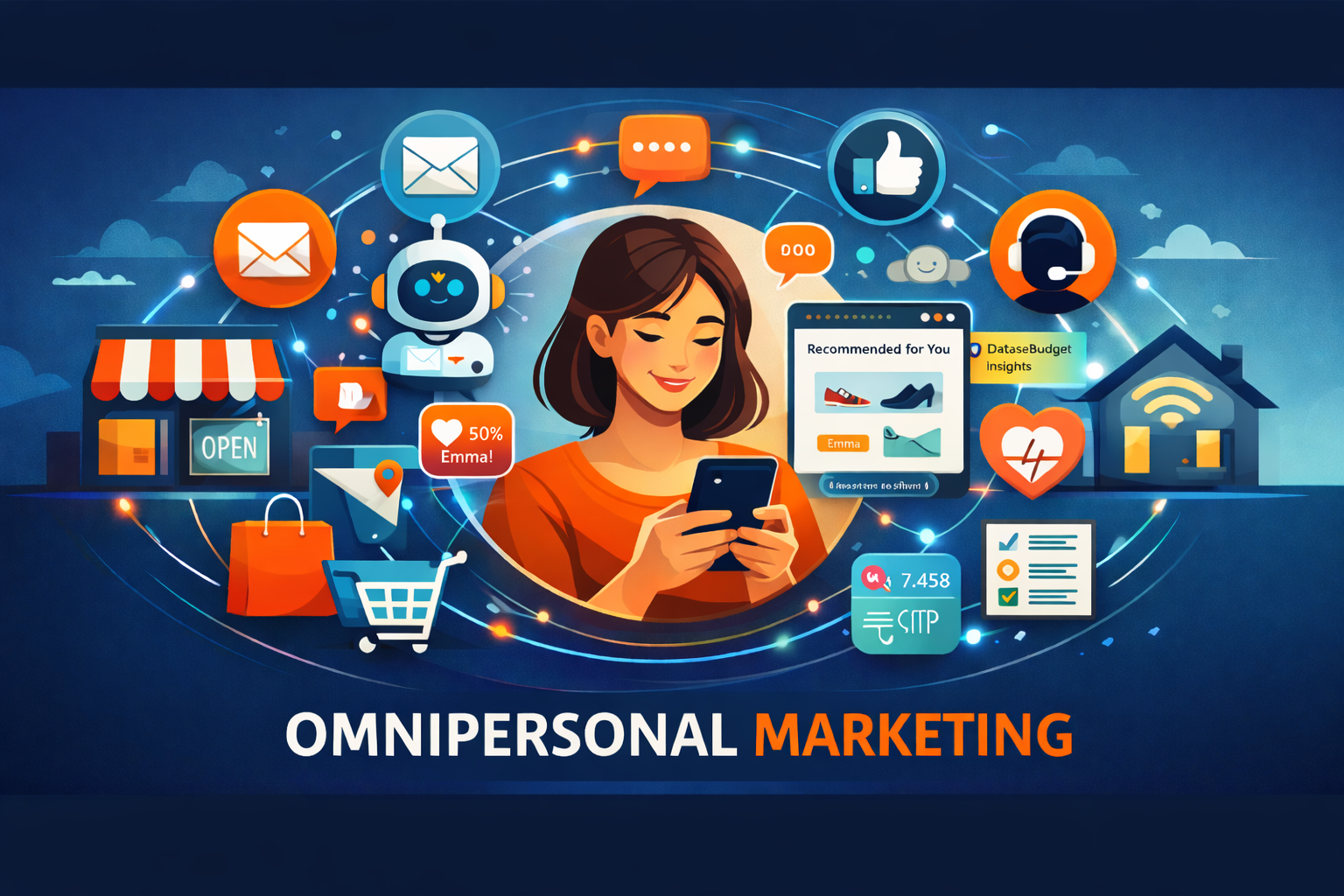
Why did Omnichannel forget about the customer? OmniPersonal places them back at the core of marketing.
In 2000, while consulting to the T-Mobile UK board of directors, I coined the concepts of Digital Channel and Omnichannel marketing. The vision was simple: create a seamless, unified customer experience across every touchpoint to put the customer at the centre of everything. But somewhere between vision and execution, the industry took a wrong turn. Omnichannel became about managing channels, not understanding customers. We built sophisticated infrastructure to deliver consistent messaging everywhere, but the person receiving those messages remained a fragmented collection of personas, never truly known.
Twenty-five years later, the technology finally exists to complete that journey. It’s called OmniPersonal Marketing, and it’s already working.
The Omnichannel Promise, And Where OmniPersonal Marketing Begins
Omnichannel marketing was always meant to be customer-centric. The goal was to unify the customer experience across every interaction, ensuring that whether someone browsed on mobile, purchased in-store, or contacted support, the brand knew who they were and what they needed.
The industry operationalised this as a channel orchestration problem. Massive investments went into Customer Data Platforms, Marketing Automation systems, and analytics tools designed to manage touchpoint consistency. Brands became experts at delivering the same generic experience everywhere — consistently mediocre across every channel.
The fundamental issue wasn’t the technology architecture. It was the data architecture. Marketing systems could see what customers did — clicks, purchases, support tickets — but never understood why. The richest personal context lived on customers’ smartphones, completely inaccessible to any enterprise marketing system.
This is where OmniPersonal thinking transforms everything.
The Personalisation Paradox That’s Now Solved
Today’s marketing leaders face an impossible contradiction. Enterprise AI investment hit $109 billion in the US in 2024, yet 74-80% of AI initiatives fail to deliver ROI, according to BCG and McKinsey research.
The core reason? AI needs rich personal data to personalise effectively, but consumers won’t, or can’t, share sensitive information with corporate cloud systems. Trust is fundamentally broken.
Every mechanism for accessing personal data is disappearing simultaneously. Third-party cookies deprecated. Apple blocking cross-app tracking. GDPR and CCPA regulations tightening. Meanwhile, customers are “in-market” only 2% of the time. The other 98%, persuasive programmatic messaging actively damages brand relationships by revealing how little brands actually understand their customers.
We have arrived at a genuine paradox: brands need more personal data to deliver better personalisation, but every available mechanism for collecting that data is either disappearing or fundamentally distrusted.
OmniPersonal Marketing resolves this paradox completely.
What Is OmniPersonal Marketing?
OmniPersonal Marketing is the natural evolution from omnichannel. Where omnichannel managed touchpoints, OmniPersonal manages the relationship — one unified, intelligent customer relationship everywhere.
OmniPersonal Marketing treats every customer as one person across every touchpoint — with their real context, real preferences, and real intent travelling with them, under their control.
This represents a fundamental shift from brands projecting personas onto customers, to customers participating in their own experience. From broadcast to co-creation. From persuasion to partnership.
The key insight behind OmniPersonal thinking: customers are “in-market” only 2% of the time, but they’re living their lives 100% of the time. OmniPersonal Marketing serves the other 98% — building emotional connection, anticipating unmet needs, earning trust that converts naturally when the customer is ready to transact.
This isn’t theoretical. OmniPersonal Marketing delivers maximum personalisation with maximum privacy. Not one at the expense of the other. Both, simultaneously, by design.
Understanding the OmniPersonal hierarchy is crucial:
- OmniPersonal Marketing is the vision — what brands achieve
- Private Personalisation is the method — how it works
- Device Native AI is the technology — what powers it
How It Works: Private Personalisation and Device Native AI
OmniPersonal Marketing becomes possible through Private Personalisation. Personal data is processed on the customer’s own device using multi-tiered intelligence — from simple deterministic rules, through probabilistic machine learning, to sophisticated generative AI models.
Zero-Shared Data: The customer’s personal data stays on their device. Calendar appointments, location patterns, browsing behavior, health metrics, financial information — it’s all processed locally, never uploaded to corporate clouds.
Zero-Party Data: Customers choose to share specific insights and preferences directly with brands — transparently, with full control. “I’m vegetarian.” “I’m training for a marathon.” “I’m planning a wedding.” This is richer, more accurate, and infinitely more trusted than any third-party data ever was.
Device Native AI provides the enterprise infrastructure to orchestrate OmniPersonal experiences. DataSapien’s platform embeds directly into brands’ existing mobile apps via SDK. No new app required. No customer friction. No cloud AI token costs.
The result transforms what’s possible with OmniPersonal approaches. Brands access an order of magnitude more personal context than cloud-based systems ever could, precisely because customers trust the architecture. A retail app can understand that a customer is gluten-intolerant, budget-conscious this month, planning meals for a family of four, and prefers quick recipes on weeknights — without ever transmitting that information to corporate servers.
The Evidence: Why OmniPersonal Marketing Is Already Working
OmniPersonal Marketing is no longer theory. DataSapien’s platform is live, production-deployed, and delivering measurable results:
- ~44X engagement improvement compared to traditional cloud-based personalisation
- 25% activation uplift in Verizon proof-of-concept deployment
- 500,000 monthly active users on CitizenMe, rebuilt on DataSapien’s Device Native AI
- Zero cloud AI processing costs — all intelligence runs on-device
- 100% privacy compliance by design — no personal data collected means no compliance risk
The platform is generating its first revenues through smart city partnerships, with an active enterprise pipeline across global retail, financial services, and travel brands. What makes these OmniPersonal results particularly significant: this is early evidence from a platform that launched in late 2025.
From Omnichannel to OmniPersonal, The Journey Completes
Twenty-five years ago, the omnichannel vision was about putting customers at the centre of everything. The industry built extraordinary technical infrastructure but somehow forgot the person in the process.
OmniPersonal Marketing finally delivers on that original promise. Not by collecting more data about people, but by giving people their own AI and inviting them to participate in their own experience.
The shift from cloud to device is inevitable. Apple, Google, Qualcomm, and MediaTek are all investing billions in on-device AI capabilities. Fortune Business Insights projects the on-device AI market will reach $107 billion by 2030, representing a massive shift in where intelligence happens.
The brands that move first — that embrace OmniPersonal approaches and build OmniPersonal relationships with customers — will create competitive advantages their rivals literally cannot replicate using traditional architectures.
DataSapien is helping organisations to give a billion people a private, personal AI, right inside the apps they use every day. Built for brands, trusted by users, and deployed on-device, with privacy by design, to achieve better outcomes for all.
That’s OmniPersonal Marketing. And it’s already working today.
Every brand’s journey to OmniPersonal Marketing is unique. Start by uncovering which customer jobs you’re not serving well today. Book a Jobs To Be Done consultation to explore how Device Native AI can transform your customer experience strategy.
Comments
One response to “What Is OmniPersonal Marketing? The Omnichannel Evolution”
[…] built to unify every customer touchpoint – still isn’t personal enough?The answer is OmniPersonal Marketing. OmniPersonal Marketing is the evolution of omnichannel that shifts from managing consistent […]