
What if the same technology used to surveil users could be re-engineered to serve them instead?
For more than a decade, SDKs (Software Development Kits) have quietly powered much of the mobile digital experience. They help apps do everything from sending notifications to displaying ads. But behind the scenes, SDKs have also been the foundation of one of the most widespread – and often invisible – data extraction systems in tech.
This blog explores how SDKs evolved from helpful developer tools into hidden agents of surveillance capitalism. And how they’re now being reimagined to empower users, not exploit them. With DataSapien’s radically different approach, we’re entering a new era of SDKs that prioritise trust, transparency and transformative engagement.
1. What Is an SDK?
An SDK, or Software Development Kit, is a bundle of code, tools and resources that developers integrate into mobile apps to add functionality. They’re like plug-and-play building blocks for services such as:
- Analytics tracking
- Push notifications
- In-app payments
- Advertising
SDKs save time and simplify development. But when they interact with personal data, they introduce trade-offs – often hidden from both users and the app developers themselves.
2. The Dark Side: How AdTech Hijacked SDKs
In the world of AdTech, SDKs became a Trojan horse for surveillance.
AdTech SDKs were designed to quietly collect vast amounts of user data from their devices. This includes:
- Behavioural data (scrolls, taps, screen time)
- Contextual data (device model, OS version, location)
- Identity linkages (via fingerprinting or probabilistic IDs)
This data was monetised – fuelling audience profiling, programmatic bidding and retargeting. For many developers, embedding these SDKs became the default monetisation model: offer a “free” app and get paid by selling access to the user’s behavioural exhaust.
The result? Surveillance capitalism at scale, declining user trust, rising compliance risk and a wave of assertive privacy legislation globally.
3. The Turning Point: Regulation, Awareness, Exhaustion and Desire
The backlash has been building.
- Regulators have intervened. GDPR, the UK’s Data Protection Act, CPRA and the EU’s DMA are all reshaping what’s legally acceptable in personal data usage.
- Platforms are changing. Apple’s App Tracking Transparency (ATT) and Google’s Privacy Sandbox are weakening the reach of AdTech SDKs.
- Users are deleting apps, refusing cookies and demanding transparency and control.
At the same time, expectations around personalisation continue to grow. People want digital experiences that are helpful, intuitive and context-aware – just not at the cost of their privacy.
This creates the opportunity for a better model.
4. A New Model: SDKs That Empower
Introducing DataSapien.
Rather than using SDKs to extract data off the device, DataSapien reverses the model. Our SDK processes data on the device, in real time, under the user’s control (For more technical information, visit the DataSapien developer site.
It harnesses Zero-Shared Data – personal data that never leaves the user’s phone – to create a multi-tiered personal intelligence. This intelligence reveals Private Personal Insights that help users make smarter decisions and engage more meaningfully with the services they trust.
When individuals choose to, they can share some of these insights as Zero-Party Data – fully permissioned, context-rich and relevant to brand experiences.
This isn’t just a more ethical model. It’s a more effective one.
5. SDKs: A Tale of Two Futures
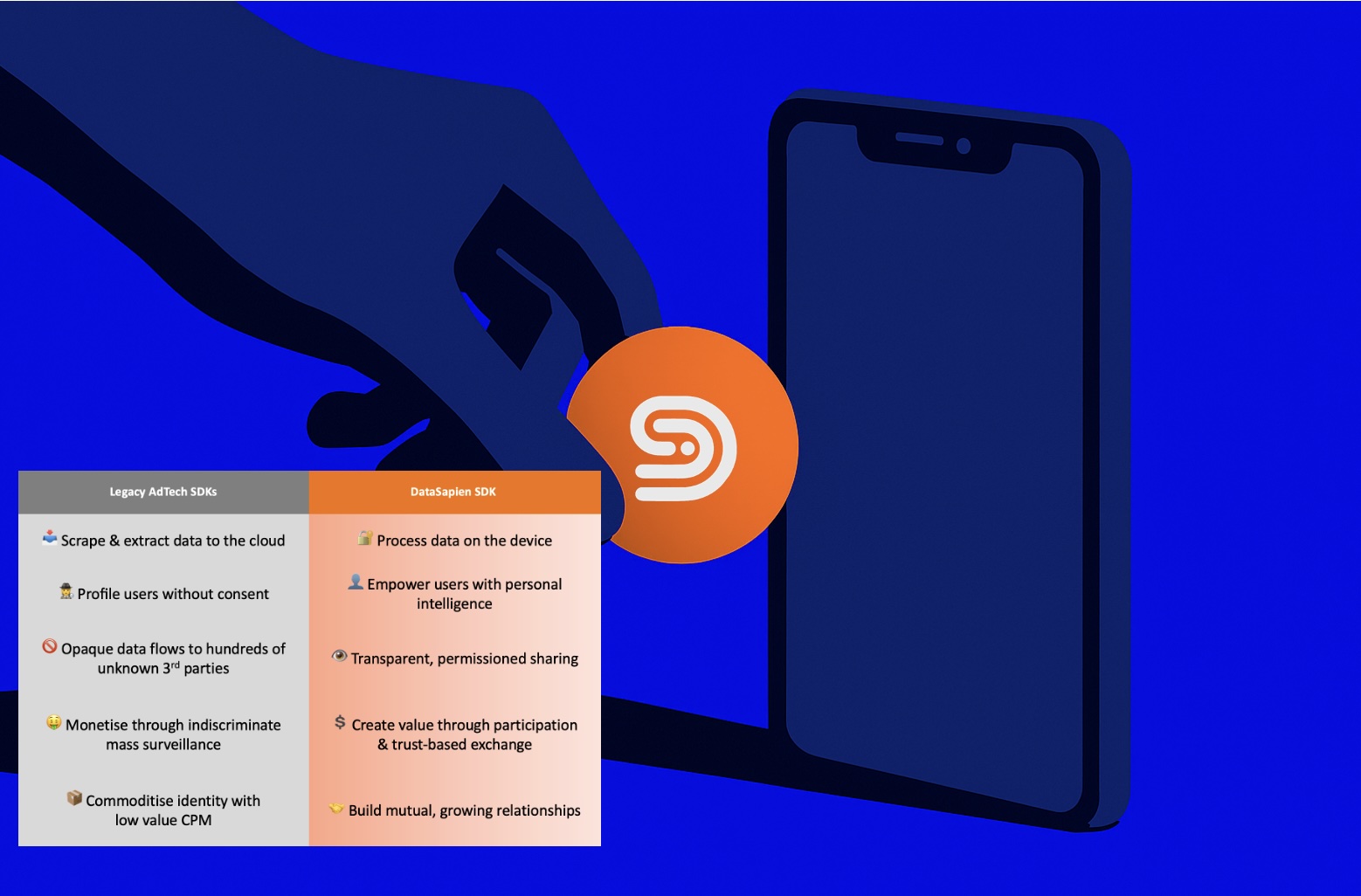
Here’s what the contrast looks like:
| AdTech SDKs | DataSapien SDK |
|---|---|
| 📥 Extract data to the cloud | 🔐 Process data on the device |
| 🕵️ Profile users without consent | 👤 Empower users with personal intelligence |
| 🚫 Opaque data flows | 👁️ Transparent, permissioned sharing |
| 💰 Monetise through surveillance | 🤝 Create value through trust-based exchange |
| 🏚️ Commoditise identity | 🏗️ Build mutual, growing relationships |

6. Why This Matters for Developers and Brands
For Developers:
- Deliver personalisation features without breaching privacy
- Differentiate with ethical, user-first UX
- Stay ahead of growing regulatory pressure
For Brands:
- Earn genuine Zero-Party Data – not inferred or modelled guesswork
- Offer contextual personalisation that drives up to 44X engagement
- Move from renting data to building customer trust and loyalty
It’s not just the right way forward – it’s the smarter one.
7. Conclusion: A Fork in the Road
SDKs are simply tools. But the way we use them shapes user experiences – and trust.
We stand at a fork in the road. Down one path lies continued data extraction, diminishing trust and regulatory headaches. Down the other lies a new model of privacy, participation and performance.
DataSapien gives you the tools to do both the right thing and the smart thing.
Because when users are in control, everyone benefits.
